How to plan a cross stitch project: size, fabric, floss and time
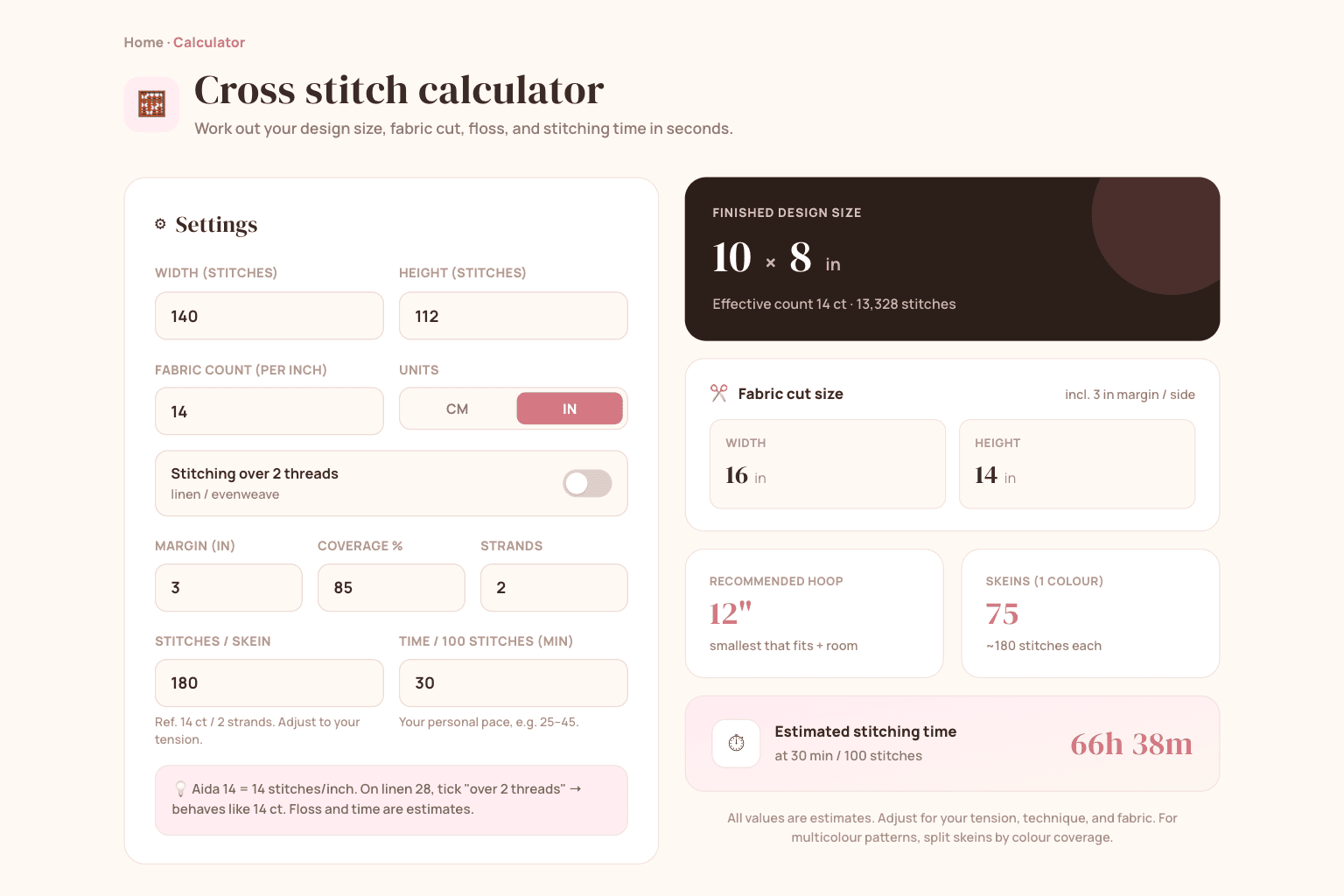
Every cross stitch project starts with the same three questions: how big will it end up, how much fabric do I cut, and how much floss do I need to buy? This cross stitch calculator answers all three at once, plus a realistic estimate of how long the piece will take. Enter the stitch count printed on your pattern and your fabric count, and everything else follows.
Your finished size is simply the stitch count divided by the fabric count — 140 stitches wide on 14-count Aida gives you 10 inches. What trips people up is the cut size, because the design is not the whole story: you need margin on all four sides for hooping, framing or lacing. Three inches per side is the usual advice, and the calculator adds whatever you choose to all four edges before giving you a number.
It works with Aida, evenweave and linen. If you stitch over 2 threads, switch the option on and the effective count halves, so 28-count linen behaves exactly like 14-count Aida. You also get a suggested hoop size — the smallest standard ring that clears the design with room to work.
Floss is the harder half of the question, because it depends on your tension, how many strands you use and how much of the canvas the design actually covers. The calculator works from stitch count, fabric count, strand count and a coverage figure, then converts thread length into DMC skeins at roughly 8 metres each. Treat the result as a shopping guide with a margin, not a precise measurement — buying one spare skein of a dominant colour costs almost nothing next to running out mid-project and finding a different dye lot.
Stitching time is the estimate people trust least and then find surprisingly close. It is built from your own pace in stitches per hour, so it gets more accurate the more honest you are about it. If you have never timed yourself, stitch a small block of 100 and check the clock — most stitchers land somewhere between 30 and 80 an hour, and confetti-heavy designs sit well below their usual rate.
This page is the full version and covers all four figures. If you only need one answer and want a shorter form, use the fabric calculator for the size to cut, or the thread and skein calculator for floss on its own. Once you know what to buy, the DMC colour chart and the thread conversion chart will help you match shades across brands.
New to all of this? Start with cross stitch for beginners for the basics, or Aida vs evenweave vs linen if you are still deciding which fabric to buy.
Frequently asked questions
It turns a stitch count into everything you need to start: the finished dimensions of your design, the fabric size to cut once margins are added, a suggested hoop, an estimate of the skeins required, and roughly how long the project will take at your own pace.
Yes, completely, and there is no account to create. Open the page, type your numbers, and read the results. Nothing you enter is stored or sent anywhere.
Yes. The unit selector at the top switches every measurement at once, and the page opens in whichever system matches your location, so most people never need to touch it.
Treat them as informed starting points rather than promises. Thread consumption swings with tension and technique, and stitching speed is deeply personal. The size and cutting figures, on the other hand, are straightforward arithmetic and you can rely on them.
Work out your own pace once and the rest follows: time yourself over 100 stitches, enter that figure, and the calculator applies it to your whole project. Most stitchers land somewhere between 25 and 45 minutes per 100 stitches, faster on large blocks of a single color, slower on confetti.
 Techniques & Tips
 Techniques & Tips
 Techniques & Tips