How to Cross Stitch on Dark Fabric (and Actually See the Holes)
Black and navy aida make colors glow, but the holes are hard to see. A light behind the fabric, the right count and a few floss tweaks make it easy.
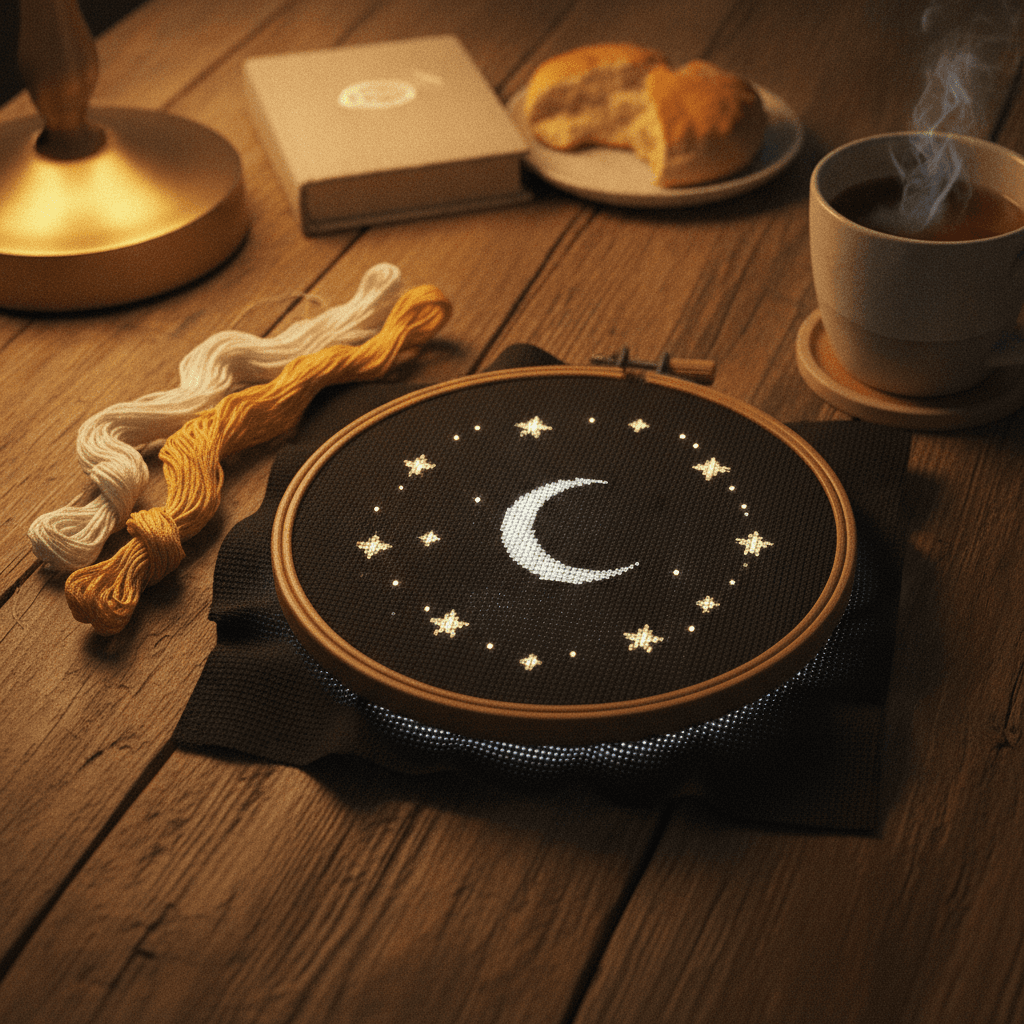
Some designs only come alive on dark fabric. A night sky, a scatter of fireflies, a bright folk-art bird: put any of them on white aida and they look washed out. Put them on navy or black and they glow.
The catch is that you can barely see the holes. Learning how to cross stitch on dark fabric is mostly about fixing that, with a few changes to your light, your fabric and your floss. None of them cost much.
Why dark fabric is so hard to stitch
On white aida the holes are dark dots against a light grid, and your eye finds them without trying. On black aida it's reversed, and the holes are tiny shadows inside a dark weave. In dim evening light they practically vanish.
Higher counts make it worse. The squares on 18-count are noticeably smaller than on 14-count, and on dark fabric that's the gap between seeing a hole and guessing at it.
Put the light behind the fabric
This is the biggest fix by far, and I'd take it over any magnifier. When light shines through the fabric from behind, every hole turns into a bright pinprick, even on black.
The easiest way is a light pad, the thin LED panel artists use for tracing. An A4 size usually runs about $20 to $35 and is big enough for most hoops. Set it on the table or across your lap, lay the hooped fabric over it, and stitch with the light coming up through the holes. If you work on a floor stand, you can clip a small panel underneath instead.
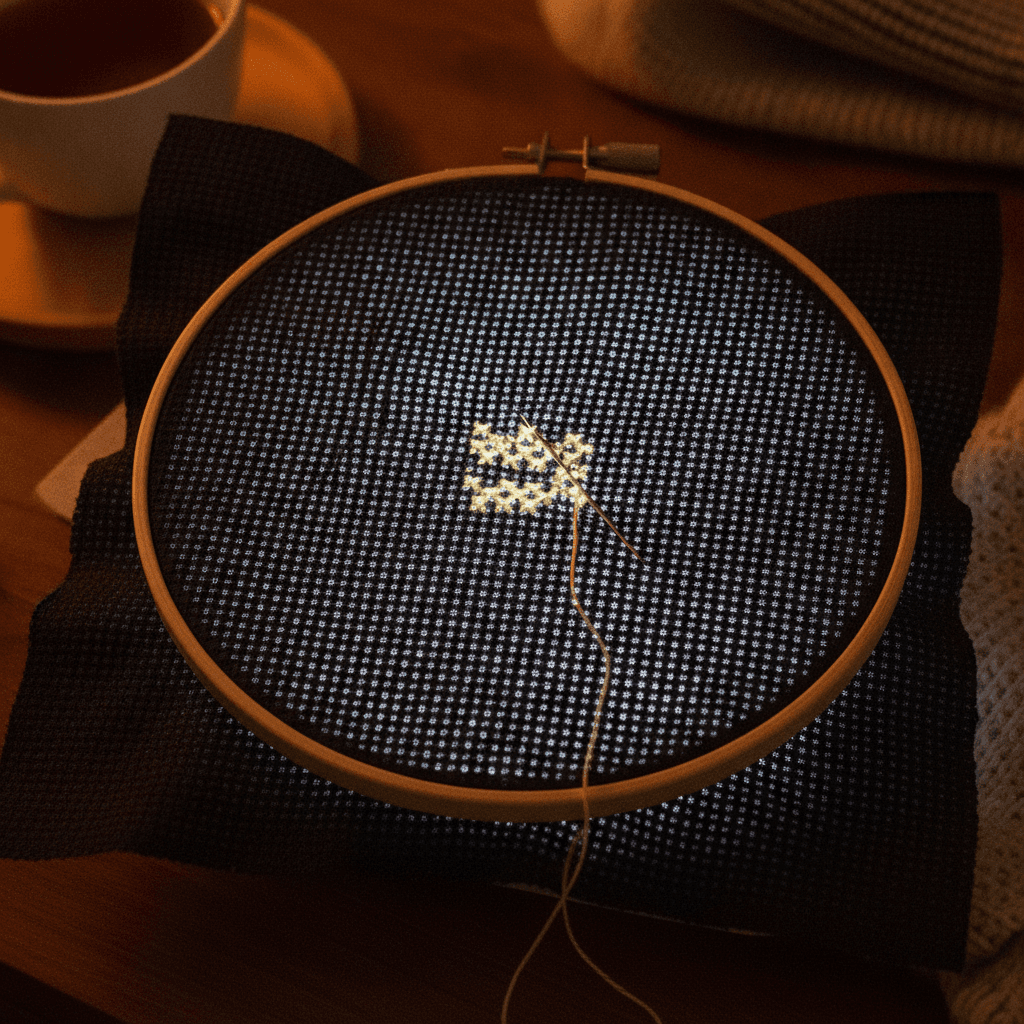
One honest downside: colors look different with light pouring through them. Before you decide a color is wrong, switch the pad off and look again under normal light.
No light pad? Try a white towel
Drape a white towel or a sheet of white paper across your lap. It bounces light back up through the fabric and makes the holes easier to read. It's not as good as a light pad. But it costs nothing, and for a quick session in daylight it does the job.
Whatever you use underneath, add a bright lamp overhead. A daylight bulb, somewhere around 5000K to 6500K, shows floss colors far more truly than a warm yellow living room bulb.
How to cross stitch on dark fabric: start with the right count
For a first dark-fabric project, use 14-count aida or even 11-count. Save 18-count black and 28-count dark evenweave for later, once you know how your eyes cope with it.
Aida is also easier than evenweave here. Its holes are bigger and more regular, so even when the light isn't ideal you can usually feel your way into the next square with the needle tip. On dark linen you can't, and a stitch that lands one thread off is almost invisible until the whole row looks wrong.
Navy, charcoal and forest green are a little kinder to the eyes than pure black, and they still give you that glow. If you're ordering fabric, the fabric calculator tells you exactly how much to buy, so you're not left with an expensive offcut.
Floss colors behave differently on dark fabric
Floss doesn't look the same against black as it does on the card or on white aida. Pale colors glow brighter. Mid-tones can turn dull and muddy. And dark colors sink right into the background: DMC 310, plain black, all but disappears on black aida, which is why designs made for dark fabric usually swap it for a dark gray like DMC 413 or leave those stitches out.
So test before you commit. Stitch a little block of each main color in a corner you'll trim off later, then look at it in daylight. If a shade isn't working, the DMC color chart makes it easy to find a neighbor a few steps lighter. And if you're adapting a design from a photo, color to thread will match its colors to real floss numbers as a starting point.
You might need an extra strand
Dark fabric peeks through light stitches more than white fabric does. If your white stitches in DMC Blanc or B5200 look thin and grayish, try three strands on 14-count instead of two. They cover noticeably better, and they eat more floss, so buy an extra skein of anything pale.
Small habits that save your eyes
Grid your fabric. A running line of white sewing thread every 10 squares turns a black void into small, countable boxes, and you pull it out when you're done.
I learned that one the hard way. My first night-sky piece was on black 14-count, stitched under a kitchen pendant at nine at night, and I worked a whole row of stars two squares to the left before I noticed.
Take a break every half hour and look at something across the room. Your eyes work harder on dark fabric, and pushing through tired is exactly when the counting mistakes start to pile up.
There's one small upside, too.
Floss carried across the back almost never shows through dark fabric, so you can be a little less fussy about traveling threads than you would be on white aida. Not careless. Just less fussy.
If you're nervous, start small: a 40 by 40 stitch moon or a single bright flower on 14-count navy, with a light pad underneath. Once you see how those colors pop, white fabric starts to look a little plain.